
Mining Royalty Frameworks Across Australian Jurisdictions
Published August 2025
Overview
Mining royalties represent a significant cost for operators across Australia. Each state and territory administers its own royalty regime, with different calculation methods, rates, and reporting requirements. For mining businesses operating across multiple jurisdictions — or evaluating new projects — understanding the differences between these regimes is essential for accurate financial planning and compliance.
How Mining Royalties Work
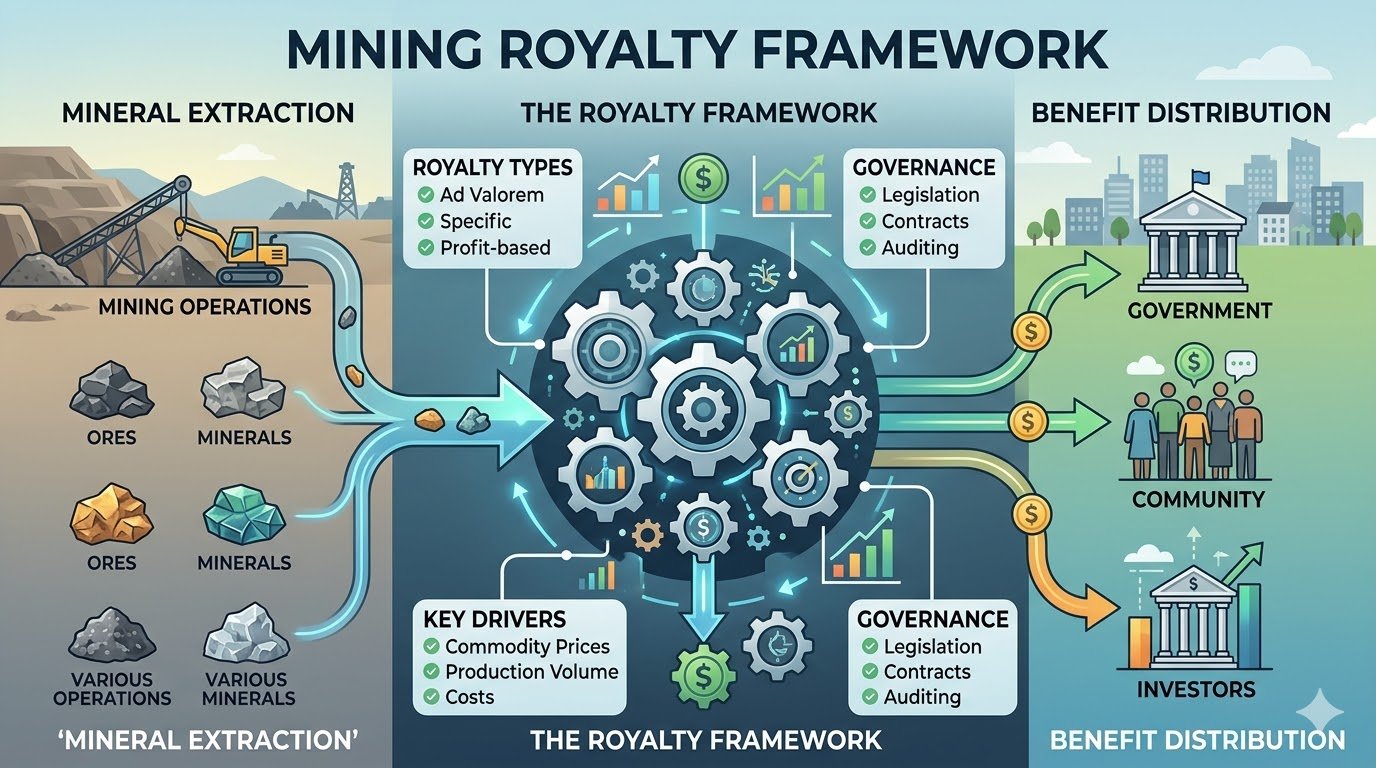
Mining royalties are payments made to state and territory governments in exchange for the right to extract mineral resources. Unlike income tax, which is administered federally, royalties are a state-level obligation. They are generally calculated on one of three bases:
- Ad valorem (value-based): A percentage of the value of minerals produced, typically assessed at the mine gate or point of sale
- Specific (quantity-based): A fixed dollar amount per tonne or unit of mineral extracted
- Profit-based: A percentage of the net profit or net revenue from mining operations
Most Australian jurisdictions use an ad valorem or hybrid approach, though the specific rates and allowable deductions vary considerably.
South Australia
South Australia applies a royalty rate of generally 3.5% of the ex-mine value for most minerals, with a 5% rate applying to certain prescribed minerals. The Mining Act 1971 and associated regulations govern the assessment and collection process. Operators must lodge royalty returns and maintain detailed production records.
The South Australian government has periodically reviewed royalty rates as part of broader fiscal policy, and operators should monitor any announced changes that may affect project economics.
Western Australia
Western Australia, as the largest mining jurisdiction in Australia, applies a tiered royalty system:
- Bulk materials (iron ore, bauxite): Typically 7.5% of the FOB revenue for fine ore, 5% for lump ore
- Concentrate minerals (gold, nickel, copper): Generally 2.5% of the royalty value
- Industrial minerals: Rates vary by mineral type
The Mining Act 1978 provides the legislative framework, and the Department of Mines, Industry Regulation and Safety administers the regime. Western Australia's royalty revenue is a significant component of the state budget.
Queensland
Queensland applies different royalty regimes depending on the mineral type. Coal royalties operate on a tiered, value-based system with rates that increase as the price per tonne rises. For other minerals, rates are generally applied as a percentage of the value at the point of disposal.
The Mineral Resources Act 1989 governs royalty obligations, and the Queensland Revenue Office administers collections. Queensland's coal royalty regime was significantly amended in 2022, introducing higher tiers for elevated coal prices.
New South Wales
New South Wales applies royalty rates that vary by mineral type, generally ranging from 4% to 8.2% of the ex-mine value. Coal royalties are assessed at different rates depending on whether the coal is extracted from an open-cut or underground operation. The Mining Act 1992 and associated regulations set out the assessment framework.
Other Jurisdictions
The Northern Territory, Tasmania, and Victoria each maintain their own royalty regimes with rates and calculation methods specific to their mineral endowments and fiscal policies. Operators expanding into new jurisdictions should obtain specific advice on the applicable regime before committing to project expenditure.
Deductibility and Interaction with Federal Tax
Mining royalties are generally deductible for federal income tax purposes as a cost of doing business. However, the interaction between state royalty obligations and federal tax positions requires careful management, particularly in relation to:
- Transfer pricing for vertically integrated operations
- Valuation methodologies for royalty assessments versus tax reporting
- Timing differences between royalty payment obligations and tax deduction recognition
- The Minerals Resource Rent Tax (MRRT), which was repealed in 2014 but may inform future policy discussions
Advisory Implications
For mining operators, royalty obligations are a core component of project economics and should be modelled accurately from the feasibility stage through to production. Differences between jurisdictions can materially affect the relative attractiveness of projects, and ongoing compliance requires dedicated systems and processes. Tax Solutions SA advises mining clients on the interaction between state royalty obligations and federal tax positions, ensuring that compliance is maintained and that available deductions are properly claimed.
Need Mining Advisory Support?
Our team understands the regulatory environment facing mining operators across Australian jurisdictions.